
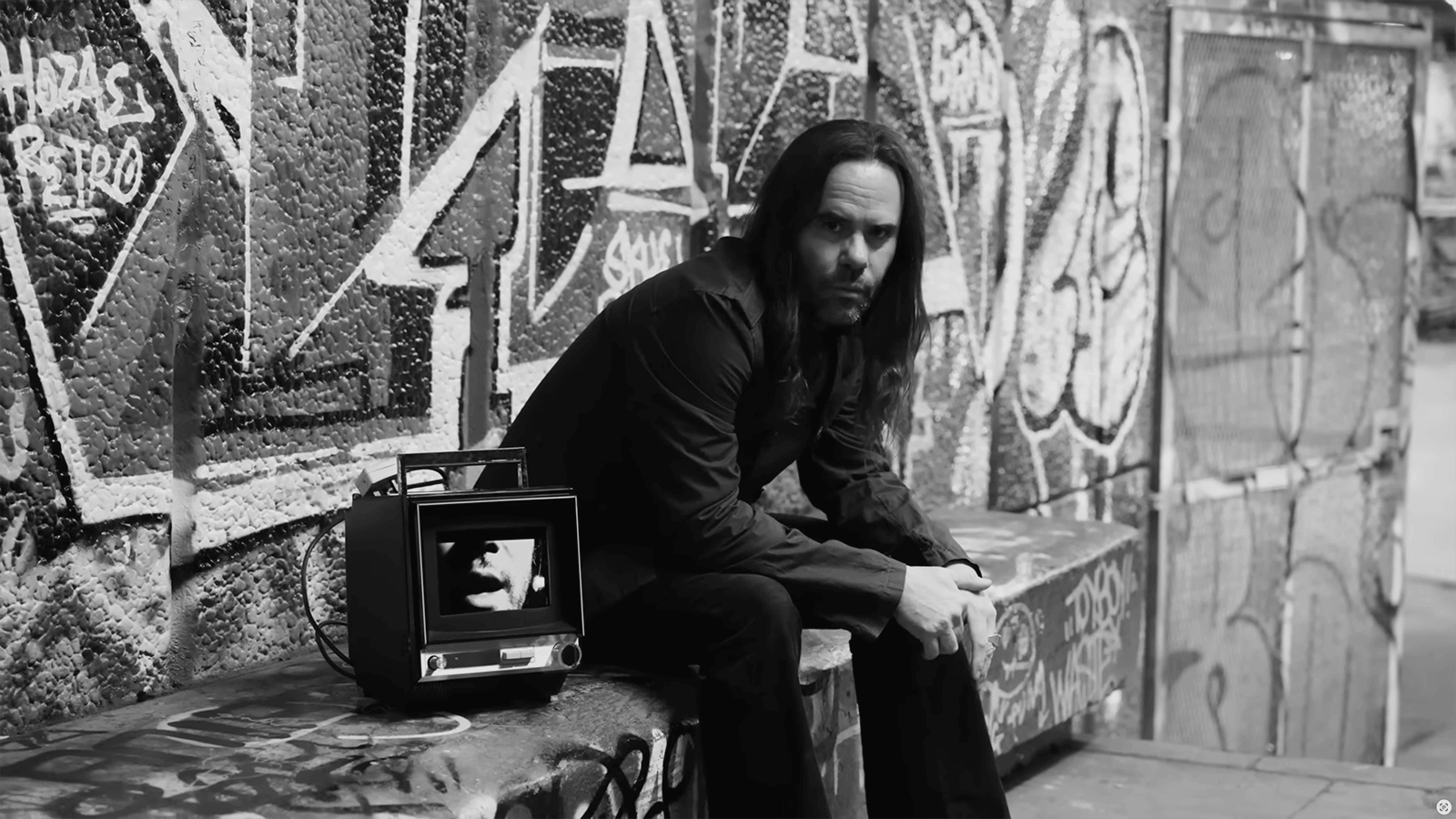
A/P/T is taking shape as a project rooted not in nostalgia, but in timing, instinct and a creative bond that found its moment again. For Antosh, the album grows out of emotional response, contrast and authenticity – not as a calculated concept, but as a body of work discovering its own identity track by track.
[Damian Paluszkiewicz] You and Perkoz have known each other for a long time, but A/P/T feels like a project that came together not only because of the right lineup, but also because of the right moment. What do you think clicked only now that made your connection lead to a full album?
[Antosh] Timing is everything I guess and it just happened organically with no pressure and that’s always the best way. We just “re clicked” backstage at a T Love gig in London and immediately started talking about working together again. Same drive, same vibe, and here we are !
Also through A/P/T I have really enjoyed stepping back in to Poland’s music scene and seeing old friends like Smolik and Myslovitz and making new connections. I consider Poland my spiritual home. I loved my time living in Warsaw and meeting and working with so many lovely people who showed me nothing but kindness as a young man. It just feels right at the moment to “come home” and work again with my friends old and new.
When you think back to how you first got to know Perkoz, do you now see any early signs that this relationship could one day lead to A/P/T?
We first met when I was in Warsaw after Mainstream broke up and I had decided to work as a solo artist, remixer and record producer. I had done some remixes for De Mono, Cool Kids Of Death etc and had sung on an a version of “Długość dźwięku samotności” with Myslovitz and the song and their album of course became a big success, so I was getting lots of offers to work with people. My girlfriend at the time worked for EMI and I had vaguely been approached about potentially producing for T Love ( I would like to have a go at remixing something from the new album, I think there are a couple of bangers on there that might work) but I was trying to work on a solo record and other projects so I put them in touch with my friend and producer Neil Simons who went on to produce for them. If my memory serves me Perkoz had some demos for songs that we worked on for several weeks at his apartment. I would go over and sift through demos he had and I thought showed promise and make some suggestions. We got on immediately but I think I was also working with Smolik at the same time on What Fuels Your Fire ? EP and on Kasia Nosowska’s Sushi album which I did a song called Electrified for. It’s all a bit vague as it’s a long time ago now
When we met again backstage in London at the T Love show it was like we hadn’t been apart at all and started talking about doing something together again. I guess A/P/T was kind of re-born that night.
The issue will become identity, or loss of it and by extension authenticity. I predict that we will culturally shift in the wake of A.I from an ‘attention’ economy (which we are currently living in) to an ‘authenticity’ economy. It’s happening now in fact.
Each new A/P/T track seems to move in a slightly different sonic direction, yet it never feels chaotic.
Well I think I have approached the song writing as cohesively as I can by reacting to as many different opportunities as I could get from Perkoz demo’s.
Brian Eno talked about the first Roxy Music album as being a conscious decision to try and give the band 10 potential futures. By this he meant that the album had very different songs, both sonically and musically. The influences were there from Krautrock and The Velvet Underground and also classic doo wop and avant garde music. The band would be able, depending on which styles worked best, to freely pursue what they liked on further albums. It wouldn’t seem unusual as they would have already laid the groundwork. This seems sensible to me with A/P/T. There are very different songs on the album to come but I hope that my voice and playing, my taste along with Perkoz unifies these elements to create a cohesive whole. Its identity is bigger than the sum of its parts if you will. Its managed chaos!
What do you think ties this project together most strongly and makes the listener still feel that it is unmistakably you?
Each other. Myself and Perkos.
English and Polish artists seem to share a similar temperament. I know Kev Fox and Andrzej have been very successful together, it’s the same simpatico I think. I get on very well with Andrzej, always have done. We are friends first. Also I think we are all quite serious about what we are trying to achieve. You can, within reason, weld strong visions on to all types of musical chassis if there is authenticity. I drew out a lot of demos that Perkos had , from various projects and timeframes and it is the ones that affected me emotionally that you are hearing. Music by its nature is an emotional experience and when its stirs those emotions in you the song tends to write itself if you are in tune with the emotions that you are feeling. Strut Your Stuff and Sleep were written on the plane back to London with me just listening over and over to the music and trying to lock down what I was feeling.
The A/P/T singles released so far have shown different shades of your music – from energy and tension to a more intimate, nocturnal mood. Looking at them now, do you see them more as a record of changing emotional states, or as a gradual process of building the project’s identity?
This is an interesting question as I think it’s both. You have to build a relationship with an audience if you are independent and that , by its nature, is gradual. It’s a slower but more rewarding process I believe, and with this way of working you discover your own identity along the way. It becomes something that you cannot really engineer, it starts to have a life of its own.
Also I guess we both come from listening to albums. The best albums tended to take you on a journey, metaphorically of some kind. Now of course this is rarer as an experience unless you are in to buying physical media . Now there are playlists that go on forever with a mix of artists or a playlist that sustains a mood etc etc etc. Physical albums are short so you have to dive in and come out the other end. They are also linear experiences unlike a playlist that can chop and change David Sylvian’s album Secrets of the Beehive is a very short album for example, yet it’s brevity is it’s power. Also the running order of the songs has been designed to flow specifically, the silence and timings between tracks is an important ingredient in its overall success as a work of art.
It feels now you dive in and drown a bit. Its fatigue that makes you change the vibe rather than being left wanting more.
So in many ways we have approached the first album as an ‘album’ and therefore it has a changeable pace, style and mood as it goes from point A to point B in a linear fashion . That’s its humanity I guess.
While working on the successive singles, was there a moment when you felt that A/P/T stopped being just a collaboration and became a fully formed world of its own?
Singles maybe a bit misleading as the songs are all from the same family. They are all guests at the same wedding, they are just coming up the aisle one at a time. I think when we release the album in it entirety, on vinyl to underline the point, this first record by us will be quite a distinct statement with all the music video’s I have made, the artwork and so on. It’s been a big project and continues to grow. The next step in the progression would be to do it live maybe in Poland . Id love to play some funky electro club in Warsaw, 100 people capacity, dark, cool as fuck, only strobes like a Jesus and Mary Chain gig or something. That’s what I call rock’n’roll.
Among the A/P/T tracks released so far, is there one that turned out to be a breakthrough for you – not necessarily the best one, but the one after which you understood more clearly what this project was really meant to be?
I think Strut Your Stuff because it’s so extreme. I made the video extreme I am quite an extreme person. I dislike routine for example. I have consciously created a life without routine. My work in the film industry is very extreme at times in terms of the hours and the stress. I sometimes wear a watch, but I don’t have a battery in it. It’s the contrarian in me that wants Strut Your Stuff as much as Sleep.
If you had to point to one sound, one image, and one word that best describe the current stage of A/P/T after “Sleep”, what would they be – and why those in particular?
You know what, In my entire life there’s one sound that I’ve never heard. The sound of Peace. I hope before I die I do. Here’s an image, a little blue dot in a sea of darkness. We are not the first beings to live on this planet but we may be the last if these cunts keep trying to blow each other up. The word? Now, I think that’s where A/P/T is, it’s a reaction to the now and I think that what’s informing the music Perkos and I are making. Its empirical rather than fantasy. And these are strange times indeed.
When a track is built around tension, it is easy to go too far and turn emotion into effect. How do you know that a song is still telling the truth rather than simply working well on a sonic level?
I think it’s when you return to a piece and it still affects you emotionally. There are of course failures along the way. But the tension is between you and the work. Its instinctive, does this piece still move me,? am I still wedded to what I am “saying” in the broadest sense, not just the lyrics.
Artist’s tend to use vocabulary in the studio like ‘are you feeling it’ rather than can you “hear” it. This is important as it underlines the reason for doing it in the first place. If it “feels” wrong then it is wrong. The Prodigy for example are more sonically driven than lyrically but when those two elements combine its brilliant. Sleaford Mods are the opposite of this. And they are also brilliant. The key with song writing is for both these elements to combine and not fight or undermine each other. Harmony makes the work cohesive
Singles maybe a bit misleading as the songs are all from the same family. They are all guests at the same wedding, they are just coming up the aisle one at a time. I think when we release the album in its entirety, on vinyl to underline the point, this first record by us will be quite a distinct statement.
Working remotely can be convenient, but it also quickly reveals whether an idea really holds up. Are there moments when you can tell right away that something sent from the other side has heart, even before you start analyzing it?
I never analyse a piece ‘musically’ as I am a non-musician. I can’t really play an instrument and have never wanted to learn how to as this becomes, in my humble opinion, learned technique and this doesn’t really work for the kind of music I tend to make. I have worked with lots of musician who, when faced with a problem or an impasse will play themselves some blues licks or a Led Zeppelin riff to remind themselves that, hey, I’m good etc. I don’t have this ability. My instruments are the computer and the studio. When I play the guitar or the synthesiser for example I really do have to engage and think about it in terms of texture and colour as I can’t think of them in terms of notes, chords, scales and so on. Its forced me to use my ears far more than my fingers. Lastly the most important thing to cultivate is judgement. The best artists deal in judgment, taste and ideas, rarely in technique. Its why first albums by bands tend to be the better ones, they have not quite got the hang of it yet. The inspiration outweighs the technical proficiency. I guess I’m more Punk than Prog in my attitude to art. The Punk thing was “here’s three chords – now start a band”. Amusingly The Human League were “ Here’s one key on a Moog, hold it down and start a band. I’m down with that .
Music production is evolving incredibly fast today – from AI to intelligent tools for editing, mixing, and sound design. Which of these changes genuinely inspire you in your work on A/P/T, and which ones do you keep the greatest distance from?
I’m intrigued but also already bored by the endless talk about A.I if I’m honest.
A.I potentially has a lot of benefits. Even down to your own health for example. A. I in theory can diagnose and prescribe specifically based on your own metabolism rather than arbitrarily ‘at a glance’ from a Doctor. I am not attacking Doctors hear to be clear. That sounds like an amazing thing. However the A.I generated music and film I have seen/heard is not so great. Also it seems like an exercise in deception. Like a gotcha moment, “can you tell whether this is A.I? I find this tedious in the extreme.
Like any tool it must be beside you, not in front of you. If it becomes dominant in the process then it follows that you would become subservient and that’s never a healthy place for creativity. I have not yet tried it in any musical context. I’m old skool, I think the struggle is part of the work, it’s the nature of the beast in a way. If A.I does the heavy lifting then will this make the work better? I doubt it but I guess the jury is out for the time being. Also does anyone really care about what goes in to the work now? We all know the story of Van Gogh’s ear but is this required or even recognised in today’s climate as valid, does it add more validity to the work, to the artist? Who knows. I just feel that the struggle IS the work, without it, without adversity as a friction how are the sparks going to fly? It’s the equivalent of the neppo baby getting on TV or a record deal or something. Then pretending they have “had it tough”. I just reach for the remote straight away. Bang. Off
The issue will become identity, or loss of it and by extension authenticity. I predict that we will culturally shift in the wake of A.I from an “attention” economy (which we are currently living in ) to an “authenticity” economy. It’s happening now in fact. The search for coffee and craft beer from small boutique sellers rather than chains. The rise of Youtube content creators Vs the legacy media. The absolute loss of trust in our political leaders and systems of governance. Even Hollywood. Everyone’s sick of actors in capes. I think that smaller more personal work, dare I say, more analogue work will start to float on the tidal wave of processed slop filling every facet of our lives.
Your music leaves a lot of space for tension, ambiguity, and the listener’s own interpretation. Do you like it when the audience fills in that world in their own way, or do you still hope that certain emotions and meanings come through in a very specific way?
Well good art is never prescriptive. The work that has always inspired me has been inclusive rather than exclusive. The artist presents the work, the audience brings the reaction and this completes the experience. Emotions are such a wide spectrum in all of us that you hope that the work encourages participation and by extension interpretation. And this interpretation is where the ‘meaning‘ resides and that’s unique to every one of us. Does On The Corner by Miles Davis ‘mean’ anything? I don’t know but I know what it “means “ to me and it’s beyond words.
If you could leave the listener with one thought after stepping into the world of A/P/T – not only after “Sleep”, but after this whole stage of your journey – what would you want to stay with them the longest?
It’s like your child leaving home and going out in to wide world, you hope that it’s accepted, has a cool time and makes people happy. Making a record is a bit like that. It grows up in public with all its strength and weaknesses. You hope that it gives people pause for thought and ultimately pleasure.
Thank you for taking the time to talk with us.
Interview by Damian Paluszkiewicz / Gazeta Muzyczna.